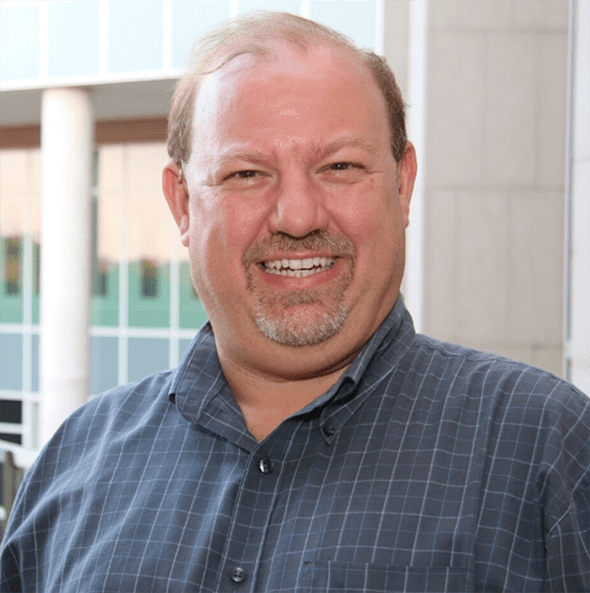
Robert Raphael applies engineering principles to understand the auditory system and develop strategies to fight hearing loss and deafness. Through basic research into the intricate workings of inner ear hair cells and the auditory nerve, his overall goal is to bridge the gap between biophysical knowledge to engineering the next generation of auditory implants.
I have a personal connection to hearing loss. We have a genetic form of dominant progressive hearing loss in our family and I lost my hearing gradually throughout my life. I needed my first set of hearing aids at the end of high school and received a cochlear implant in 2012. In retrospect, I waited too long to get the cochlear implant. I’m the oldest and four of my siblings now have cochlear implants too.
The Raphael lab has studied the structure and function of biological membranes for two decades. Membranes play a large role in the physiology of hearing, mediating coupling between electrical, mechanical and transport processes essential for proper auditory function. For example, the membrane protein prestin transduces electrical signals into mechanical motion and increases the sensitivity of human hearing. A network of membrane transporters sets up the ion gradients that power the sensing of mechanical vibrations by inner ear hair cells.
The Raphael group developed the first biophysically-based computational model of ion transport in the inner ear. This research is currently funded by a collaborative National Institutes of Health R01 award with colleagues at the University of Chicago. The overall goal is to integrate experimental data on the spatial distribution and electrical properties of ion channels into a multiscale model of synaptic transmission and neural encoding.
New collaborative research between Raphael and investigators at Rice and Baylor College of Medicine involves the application of genetically encoded voltage proteins to study firing patterns in the auditory nerve and the development of a carbon nanotube fiber cochlear implant.
Raphael is also the principal investigator on a $3 million IGERT grant from the National Science Foundation titled Neuroengineering: From Cells to Systems, which has catalyzed the development of neuroengineering at Rice University.
Raphael has received several honors for research and education, including an NSF CAREER Award (2005), three Hamill Innovation Awards (2006, 2007, 2018) from the Institute of Biosciences and Bioengineering (IBB), the Faculty Teaching/Mentoring Award from the Rice Student Association (2007), the Charles W. Duncan Jr. Achievement Award for Outstanding Faculty (2010), and a Collaborative Research Award from the John S. Dunn Foundation (2018)